Types of Freelancing in 2026 (Complete Guide for Beginners)
Freelancing is a flexible work model where individuals offer services to clients independently instead of working as full-time employees. In 2026, freelancing continues to grow rapidly due to remote work expansion, AI-powered productivity tools, and access to global clients through online platforms. However, with so many options available, many beginners feel overwhelmed and unsure about which path to choose.
Understanding the different types of freelancing is the first step toward building a sustainable career. This guide is designed for students, career switchers, and professionals exploring independent work. You’ll discover a clear breakdown of freelancing categories based on skills, industries, and income models—plus practical guidance to help you decide which type fits your goals, strengths, and long-term vision.
What Are the Different Types of Freelancing?
The different types of freelancing are categories of independent work based on skills, industry focus, income model, and work structure. They include creative services, technical roles, consulting, and AI-based services. Freelancing can be done online or offline and may be part-time, full-time, project-based, or retainer-based depending on career goals.
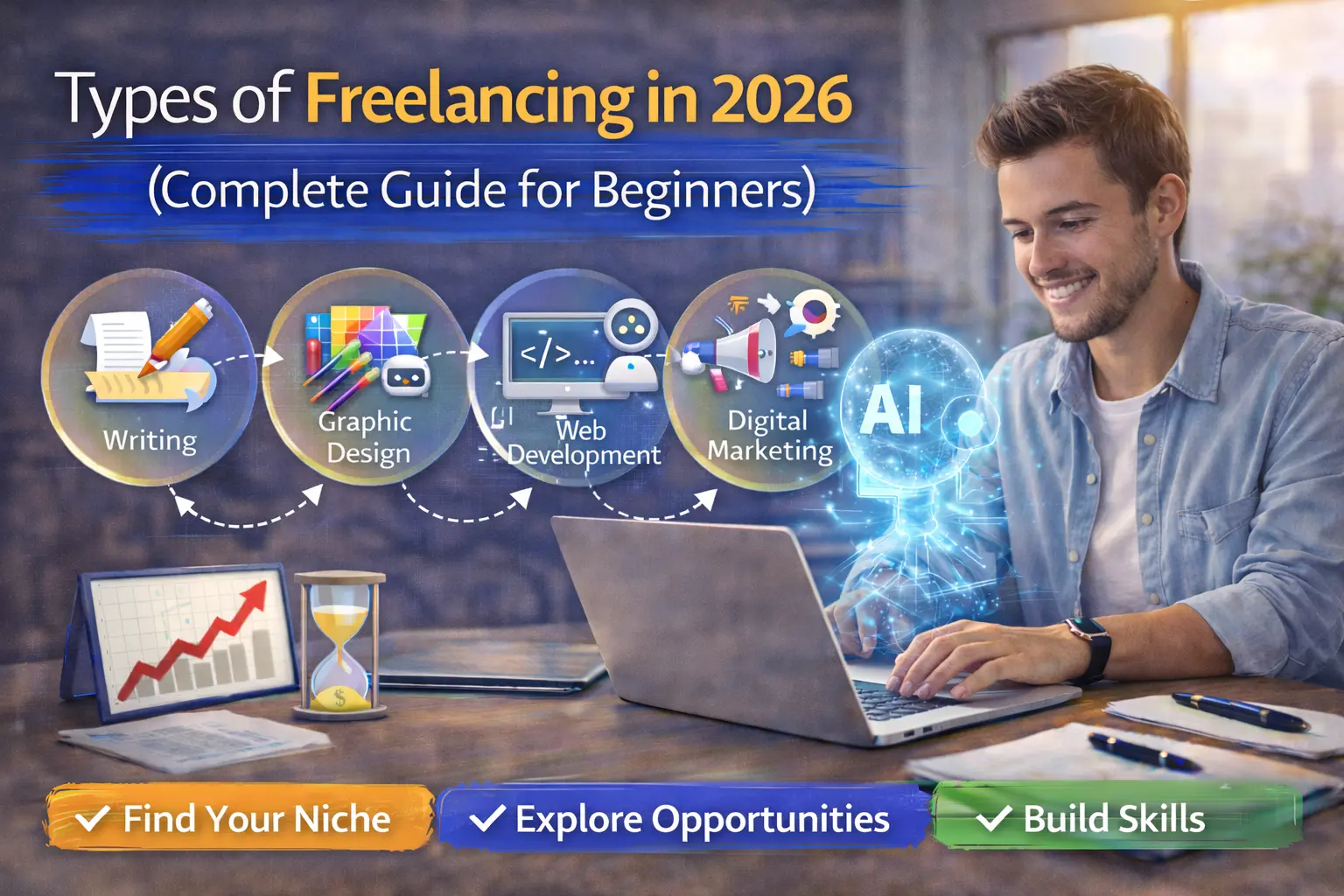
Main Types of Freelancing
- Writing & Content Creation
- Graphic & Brand Design
- Web & Software Development
- Digital Marketing & SEO
- Video Editing & Media Production
- Virtual Assistance
- Consulting & Strategy
- AI & Automation Services
- Online Gig-Based Freelancing
- Retainer & Contract Freelancing
Simple categories. Clear direction. Multiple income paths.
1. Skill-Based Types of Freelancing (Most Common)
Most freelancers are categorized by the skill they offer. This is the most common way to classify types of freelancing because clients usually search for services based on expertise.
Writing & Content Freelancing
Writers provide content that helps businesses communicate, educate, and sell.
Includes:
- Blog writing
- Copywriting
- Technical writing
- Script writing
- SEO writing
Income potential:
Beginner writers may start with modest project rates, while experienced copywriters and technical writers can command premium pricing, especially when results are measurable.
Graphic & Brand Design Freelancing
Designers help brands create visual identities and digital assets.
Includes:
- Logo design
- Brand identity systems
- Social media graphics
- UI/UX design
- Packaging design
Branding and UI/UX design tend to have higher income potential due to strategic value.
Web & Software Development
Developers build and maintain websites, applications, and software systems.
Includes:
- Frontend development
- Backend development
- App development
- WordPress development
- Freelance software engineering
This is one of the highest-paying freelance categories due to technical complexity.
Digital Marketing & SEO
Marketers help businesses attract traffic, generate leads, and increase revenue.
Includes:
- SEO specialist
- Paid ads manager
- Social media marketing
- Email marketing
- Funnel optimization
Freelancers who focus on revenue-driven results often earn higher long-term retainers.
Video Editing & Media Production
Media freelancers create visual and audio content.
Includes:
- YouTube editing
- Short-form video editing
- Animation
- Podcast editing
With the growth of content platforms, demand continues to rise.
Virtual Assistance & Admin Services
Virtual assistants support businesses operationally.
Includes:
- Email management
- Research
- Scheduling
- Data entry
This is beginner-friendly and suitable for part-time freelancers.
Consulting & Strategy Freelancing
Consultants offer expert advice and strategic direction.
Includes:
- Business consulting
- Marketing strategy
- Financial consulting
- Career coaching
This category typically requires experience but offers high-ticket potential.
AI & Automation Freelancing (2026 Trend)
AI-related services are rapidly growing.
Includes:
- Prompt engineering
- AI content optimization
- Automation setup
- AI workflow integration
This is a high-growth category as businesses integrate AI into operations.
2. Industry-Based Types of Freelancing
Some freelancers specialize not by skill alone, but by industry focus.
Tech Freelancing
Working with:
- SaaS companies
- Startups
- Software firms
- App development teams
Services may include development, cybersecurity, or DevOps support.
Creative Industry Freelancing
Serving:
- Agencies
- Influencers
- E-commerce brands
- Media companies
Common roles: design, video production, branding.
Finance & Accounting Freelancing
Providing:
- Bookkeeping
- Financial reporting
- Tax preparation
- Financial consulting
Strong demand from small businesses and startups.
Legal Freelancing
Includes:
- Contract drafting
- Legal research
- Compliance consulting
Often requires certifications or legal background.
Healthcare Freelancing
Services may include:
- Medical writing
- Healthcare consulting
- Telehealth support
- Documentation assistance
Specialized and regulated field.
3. Work Model Types of Freelancing
Freelancing can also be categorized by how the work is structured.
Online Freelancing
- Work done remotely
- Clients sourced globally
- Platforms and direct outreach
Most common model in 2026.
Offline Freelancing
- Local photography
- Tutoring
- Event-based services
Less dependent on online platforms.
Gig-Based Freelancing
- Short, fixed services
- Predefined deliverables
- One-time transactions
Common in creative marketplaces.
Contract-Based Freelancing
- Longer projects
- Defined scope
- Fixed timeline
Often used in development and consulting.
Retainer Freelancing
- Monthly recurring payment
- Ongoing services
- Stable income structure
Preferred model for income predictability.
4. Income-Level Types of Freelancing
Freelancers also differ by income structure and commitment level.
Side Hustle Freelancing
- Part-time work
- Extra income source
- Flexible scheduling
Popular among students and employees.
Full-Time Freelancing
- Primary income source
- Requires client pipeline stability
- Structured business mindset
High-Ticket Freelancing
- Premium consulting
- Strategic services
- High-value problem solving
Focuses on fewer clients, higher pricing.
Passive Income Freelancing
- Selling templates
- Creating online courses
- Digital products
Adds income beyond hourly work.
5. Platform-Based Types of Freelancing
Your chosen platform influences how you work and attract clients.
Marketplace Freelancing
Proposal-based model similar to platforms like Upwork.
- Competitive bidding
- Long-term contracts
- Skill-focused positioning
Gig Marketplace Freelancing
Service listing model similar to Fiverr.
- Pre-packaged services
- Search-based visibility
- Shorter projects
Direct Client Freelancing
Client acquisition through:
- Email outreach
- Personal branding
Higher control, no platform fees.
Premium Network Freelancing
Screened platforms or curated networks.
- Higher rates
- Lower competition
- Strict entry requirements
6. Beginner vs Advanced Freelancing Types
Not all types of freelancing require the same experience level. Some are beginner-friendly entry points, while others demand deep expertise and strategic thinking.
Beginner-Friendly Types
These are easier to enter with basic training and practice:
- Content writing – Blog posts, simple website copy, product descriptions
- Basic design – Social media posts, simple logos, Canva-based graphics
- Virtual assistant (VA) services – Email management, scheduling, research
These roles focus more on execution than strategy and are ideal for building your first portfolio and client base.
Intermediate Types
These require stronger technical understanding and measurable results:
- SEO (Search Engine Optimization)
- Paid ads management (Google Ads, Meta Ads)
- Web or app development
Clients expect clear outcomes—traffic growth, lead generation, or functional systems.
Advanced / Expert Freelancing
These roles are strategic and often high-ticket:
- Strategy consulting (business, marketing, operations)
- Product development (SaaS, digital products)
- Automation systems & AI integration
Advanced freelancers sell expertise and transformation—not just task completion.
7. Which Type of Freelancing Is Best for You?
Choosing the right type depends on alignment between your skill level, goals, and lifestyle.
Use this decision framework:
Consider These Factors:
- Skill Level – Beginner, intermediate, or expert?
- Income Goal – Side income or full-time career?
- Time Availability – Few hours weekly or full commitment?
- Risk Tolerance – Comfortable with income fluctuation?
- Long-Term Vision – Specialist, consultant, or agency builder?
Simple Selection Matrix
| Situation | Recommended Type |
| Beginner + Part-time | Content writing, VA services, basic design |
| Beginner + Full-time goal | Writing + SEO upgrade path |
| Technical background | Development, automation, AI services |
| Marketing experience | Paid ads, funnel optimization, strategy |
| Entrepreneurial mindset | Consulting, retainers, high-ticket services |
The best type is the one that matches both your current ability and future ambition.
8. Most Profitable Types of Freelancing in 2026
Some categories command higher rates because they directly impact revenue or efficiency.
High-Income Freelancing Categories:
- AI automation – Businesses want workflow optimization.
- Software development – High technical barrier, strong demand.
- Marketing strategy – Direct revenue growth services.
- Conversion optimization – Improves sales performance.
- High-end branding – Strategic positioning for businesses.
These roles are profitable because they:
- Solve expensive problems
- Increase business revenue
- Reduce operational costs
- Require specialized expertise
High income usually follows high impact.
9. Common Mistakes When Choosing Freelancing Type
Choosing incorrectly can slow your progress.
Avoid these mistakes:
- Following trends blindly without skill alignment
- Ignoring real market demand
- Choosing oversaturated niches with low budgets
- Underestimating the time required to build competence
- Switching types too quickly without consistency
Freelancing rewards depth, not constant direction changes.
10. How to Start After Choosing Your Type
Once you select your freelancing type, follow this roadmap:
- Learn the core skill – Build basic competence.
- Validate demand – Confirm buyers are paying for it.
- Build a portfolio – Create proof-based samples.
- Pick a platform – Choose one main channel.
- Apply consistently – Build momentum through repetition.
For deeper guidance, explore:
→ How to Start Freelancing
→ Freelancing Tips
→ Freelancing Platforms Guide
Choosing the right type is the beginning.
Consistency turns it into income.
Frequently Asked Questions About Types of Freelancing
Conclusion
Freelancing is not limited to one career path. There are many types of freelancing—based on skills, industries, income models, and work structures. From writing and design to development, consulting, and AI automation, the opportunities are broad and flexible.
The key is not choosing the “trendiest” option. It’s choosing a type that aligns with your current skill level and real market demand. Start simple. Focus on building competence and proof. As your confidence and experience grow, you can specialize and move toward higher-value services.
Freelancing rewards clarity and consistency.
Pick one path.
Build skill.
Validate demand.
Take action.
The best freelancing type for you is the one you start and improve consistently.