

How to Freelance in Different Life Situations (Students, Parents, Entrepreneurs)
Remote freelancing tips are more important than ever as professionals build location-independent careers in 2026. Remote freelancing means offering services to clients online—without being tied to a physical office. As AI tools accelerate workflows and global talent competes across borders, opportunities are expanding—but so is competition.
More people are choosing remote work for flexibility, freedom, and income potential. However, working from home also brings challenges: constant distractions, blurred work-life boundaries, burnout, and inconsistent routines.
This guide is designed for remote freelancers, entrepreneurs, and digital workers who want structure—not chaos. By the end, you’ll have a practical productivity system, smarter time management strategies, and a clear roadmap to build stable, sustainable income while working remotely.
What Are Remote Freelancing Tips?
Remote freelancing tips are practical strategies that help independent professionals stay productive, manage time effectively, communicate clearly with clients, and maintain healthy work-life boundaries while working online. These tips focus on building structured routines, reducing distractions, using smart systems, and creating sustainable income in a competitive remote work environment.
15 Remote Freelancing Tips That Actually Work
- Create a fixed daily structure instead of working randomly
- Use time blocking to protect deep focus hours
- Separate deep work and communication windows
- Eliminate digital and physical distractions
- Use AI tools strategically to speed up execution
- Set clear client communication boundaries
- Track your work hours to measure productivity
- Avoid multitasking and focus on one task at a time
- Build a weekly planning ritual to stay organized
- Use productivity systems, not just motivation
- Maintain clear work-life separation at home
- Track finances consistently to reduce stress
- Invest regularly in skill upgrades
- Build recurring clients for income stability
- Think long-term like a business owner, not a task worker
1. Understand the Reality of Remote Freelancing in 2026

Remote freelancing in 2026 is no longer a niche lifestyle — it’s mainstream. Businesses across the world now hire remote talent by default, not exception. This growth has created more opportunity, but also intense global competition.
You’re no longer competing with freelancers in your city. You’re competing with skilled professionals worldwide.
At the same time, AI productivity tools have changed expectations. Clients now expect:
- Faster turnaround times
- Higher output quality
- Better communication
- Strategic thinking
AI tools can speed up drafting, research, design, coding, and automation. But they also raise the bar. Freelancers who rely only on raw effort struggle. Those who combine systems + discipline + smart tools win.
Here’s the hard truth:
Freedom without structure equals chaos.
Remote freelancing offers flexibility — but without discipline, it leads to:
- Inconsistent income
- Burnout
- Missed deadlines
- Scattered focus
In 2026, discipline is your competitive advantage.
2. Build a Daily Structure That Supports Deep Work
One of the most important time management tips for freelancers is simple: build structure before building income. Without a schedule, your day disappears into distractions.

Time Blocking Method
Time blocking means assigning specific hours to specific tasks instead of reacting all day.
Use:
- 90-minute deep work blocks
- Dedicated communication windows
Example daily structure:
- 9:00–10:30 → Deep client work
- 10:30–11:00 → Break
- 11:00–12:30 → Project execution
- 2:00–3:00 → Emails and messages
Separating deep work from communication prevents constant interruptions.
Morning Setup Routine
How you start your day determines your output.
Instead of opening email first:
- Review priorities
- Identify top 3 tasks
- Schedule deep work
- Then check messages
Planning first protects your attention.
If you open email immediately, you start your day reacting instead of leading.
Weekly Planning System
Daily planning helps.
Weekly planning transforms.
Create a Sunday planning ritual:
- Review active projects
- Set weekly revenue targets
- Identify client deadlines
- Batch similar tasks together
Task batching example:
- All proposals on one day
- All content writing on one block
- All calls grouped together
This reduces mental switching costs and increases efficiency.
Remote freelancing rewards those who think in systems, not in daily motivation.
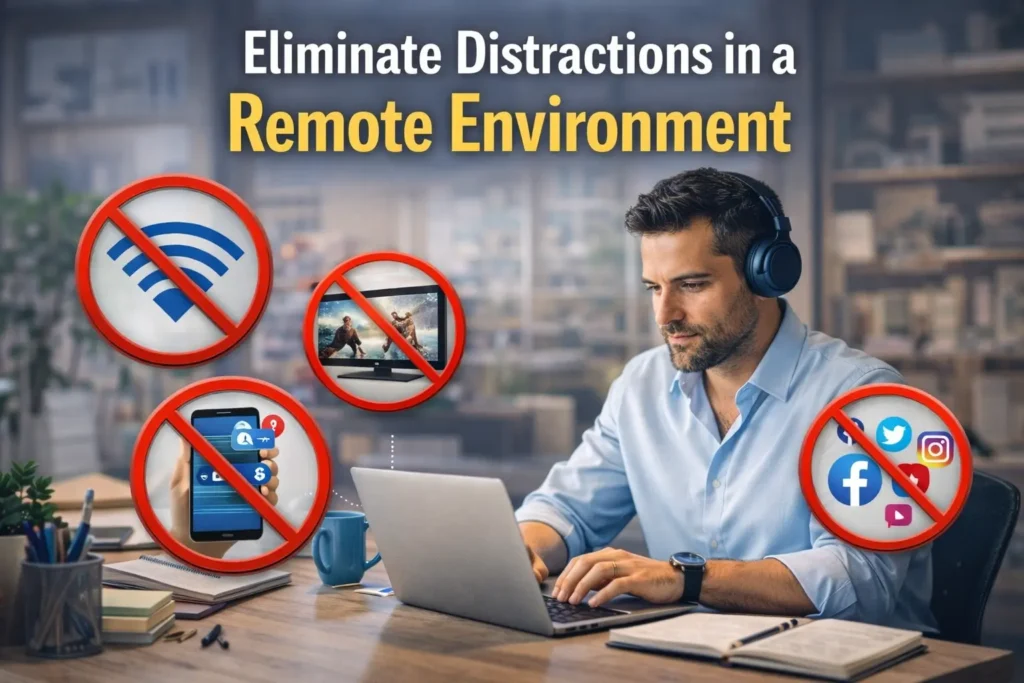
3. Eliminate Distractions in a Remote Environment
Working from home introduces invisible productivity killers.
Digital Distraction Control
Control your environment before it controls you.
Implement:
- Phone on silent during deep work
- Social media restricted to scheduled breaks
- Website blockers during focus blocks
Small interruptions compound into lost hours.
Protect attention like you protect income.
Workspace Optimization
Your environment shapes your focus.
Create:
- A dedicated work zone
- Minimal clutter
- Comfortable ergonomic setup
- Good lighting
Avoid working from bed or couch long-term.
Your brain associates spaces with behavior.
Work space = focus.
Relax space = recovery.
Deep Work vs Shallow Work
Deep work:
- High concentration
- Complex problem-solving
- Creative output
- Strategic thinking
Shallow work:
- Email replies
- Minor edits
- Admin tasks
- Notifications
Remote freelancers who spend most of their time in shallow work feel busy but earn less.
4. Create Client Communication Boundaries
Remote freelancing often fails not because of skill, but because of blurred boundaries. When clients assume you are always available, your productivity suffers. Clear communication rules increase professionalism and reduce stress.

Define Response Time Policy
Set expectations early.
For example:
“I respond within 24 business hours.”
Or:
“My communication window is between 10 AM – 4 PM (Monday–Friday).”
When you define response times:
- Clients don’t expect instant replies
- You avoid constant interruptions
- You protect focus
Boundaries build trust — not distance.
Avoid the Always-Online Trap
Being online all day does not equal productivity.
The “always available” freelancer:
- Checks messages constantly
- Switches tasks repeatedly
- Feels mentally exhausted
Instead:
- Schedule communication blocks
- Turn off notifications during deep work
- Log off after work hours
Availability without structure leads to burnout.
Protect Deep Work Hours
Deep work is your income driver.
You can say:
“I’ll review this during my next work block and get back to you tomorrow.”
Or:
“I’m currently in a production window. I’ll respond after 3 PM.”
Professional boundary scripts allow you to stay polite while protecting focus.
Communication discipline is one of the most powerful remote freelancing tips in 2026.
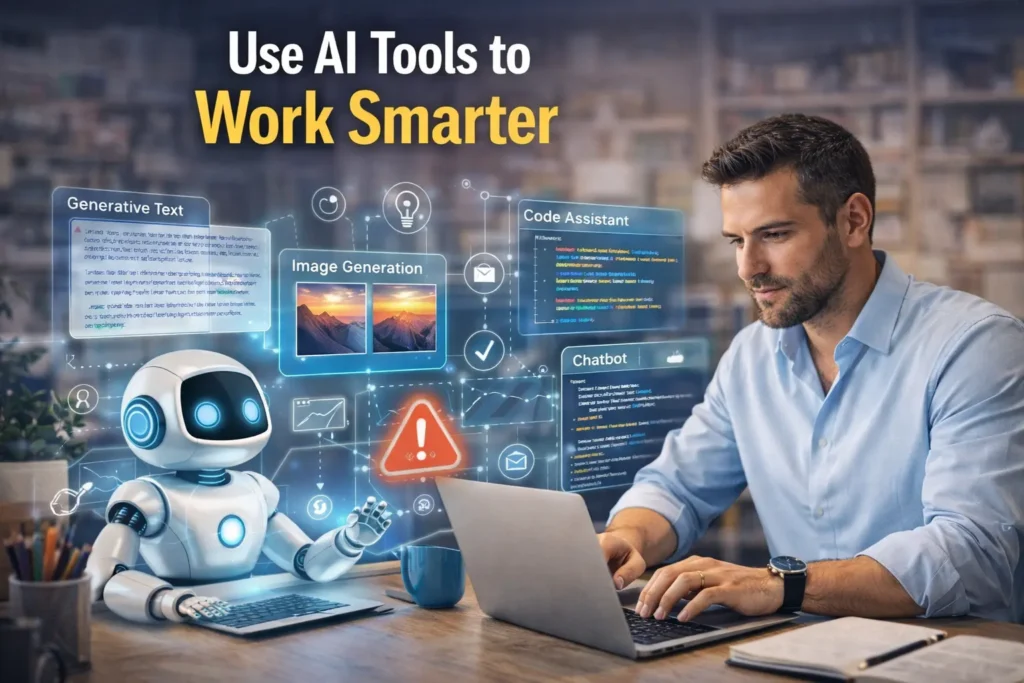
5. Use AI Tools to Work Smarter (2026 Focus)
AI is not optional anymore. It’s a productivity multiplier.Freelancers who ignore AI move slower.
Freelancers who use it strategically gain leverage.
AI for Research & Drafting
Use AI tools to:
- Generate draft outlines
- Summarize research
- Brainstorm ideas
- Refine messaging
- Improve structure
This reduces startup time for projects.
Instead of staring at a blank page, you start with momentum.
AI for Automation
AI can automate:
- Email responses
- Proposal drafts
- Data analysis
- Social media scheduling
- Repetitive admin tasks
Automation reduces shallow work.
That gives you more time for high-value strategic tasks.
AI for Productivity Tracking
Some AI-powered tools help:
- Analyze time usage
- Detect productivity patterns
- Identify focus leaks
Data-driven improvement beats guesswork.
Why Strategy Beats Automation
AI speeds execution.
Human strategy drives outcomes.
AI cannot:
- Understand emotional nuance deeply
- Align long-term brand direction
- Make contextual business decisions
Remote freelancers win when they combine:
AI efficiency + human judgment + strategic thinking.
Use AI to move faster.Use strategy to move smarter.
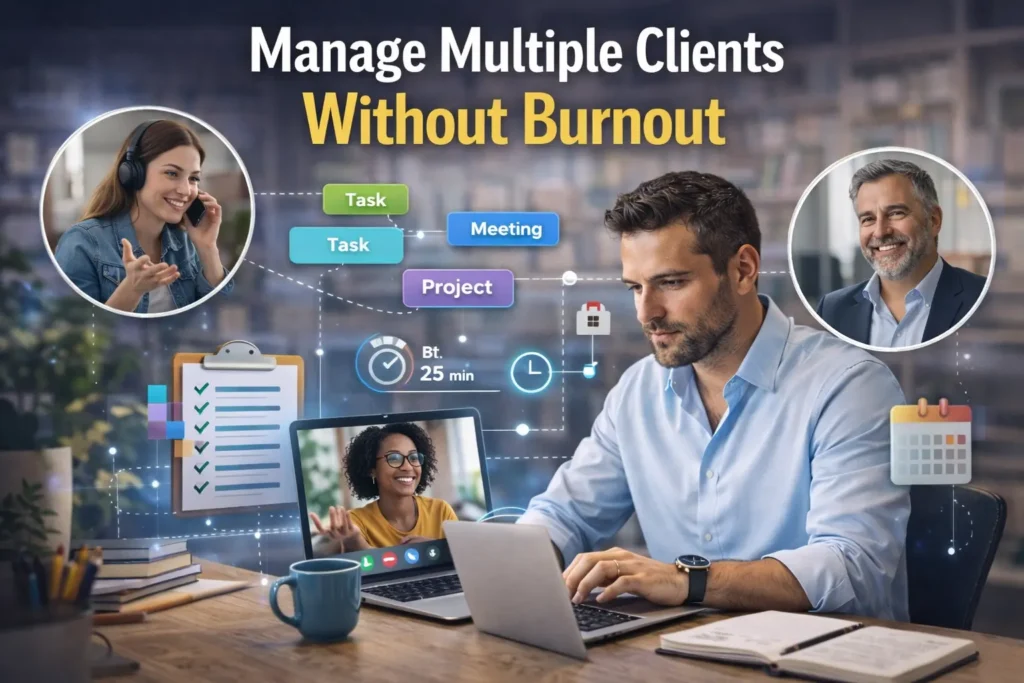
6. Manage Multiple Clients Without Burnout
Growth often creates a new problem: overload. Managing multiple clients requires systems — not memory.
Project Pipeline Tracking
Track every project stage:
- Lead contacted
- Discovery call completed
- Proposal sent
- Active project
- Invoice pending
- Completed
Visual pipelines reduce mental clutter.
CRM System for Freelancers
You don’t need complex enterprise software.
Simple tools work:
- Notion – Custom dashboards and tracking
- Trello – Kanban-style project boards
- Asana – Task and milestone management
The goal is visibility.
If you can see your workload, you can control it.
Avoid Overbooking
More projects do not always mean more income.
Overbooking leads to:
- Missed deadlines
- Reduced quality
- Burnout
- Poor reviews
Always leave buffer capacity.
Growth should feel sustainable, not overwhelming.
Capacity Planning Formula
Simple rule:
Calculate:
Available work hours per week
Minus admin time
Minus learning time
Minus buffer time
Only book projects that fit remaining deep work capacity.
Example:
40 hours total
– 8 hours admin
– 5 hours learning
– 5 hours buffer
22 productive hours
Book projects accordingly.
Remote freelancing becomes sustainable when you manage energy — not just time.Systems reduce stress.
Clarity increases income.
Discipline protects longevity.
7. Build Entrepreneur-Level Thinking
If you want long-term success, you must move beyond the freelancer mindset and adopt entrepreneurial thinking. Many powerful freelancing tips for entrepreneurs revolve around systems, leverage, and recurring income.

Freelancers vs Entrepreneurs
Task-Based Mindset (Freelancer Mode):
- Focuses only on completing assigned work
- Trades hours for money
- Reacts to client demands
- Thinks short-term
System-Based Mindset (Entrepreneur Mode):
- Builds processes and workflows
- Creates predictable income
- Thinks about positioning and leverage
- Plans long-term growth
Entrepreneurs ask:
“How can I build this once and benefit repeatedly?”
Freelancers ask:
“What task do I need to finish today?”
Shift your mindset.
Build Recurring Revenue
Income instability is the biggest stress in remote freelancing.
Recurring revenue solves that.
You can build it through:
- Retainers
- Ongoing monthly contracts
- Maintenance agreements
- Long-term collaboration packages
Recurring income:
- Reduces stress
- Improves forecasting
- Saves time on constant client hunting
Stability increases focus.
Stop Trading Only Time for Money
Pure hourly work limits your growth.
To increase leverage:
- Offer packages
- Create consulting layers
- Build digital resources
- Develop reusable systems
The goal is not to work more hours.
The goal is to increase value per hour.
Entrepreneurial thinking turns freelancing into a scalable model.
9. Protect Mental Health & Avoid Burnout
Freedom without balance becomes exhaustion. Remote work can blur boundaries between professional and personal life.

Set Working Hours
Define clear work hours.
Example:
9 AM – 5 PM, Monday to Friday.
Outside these hours:
- No client responses
- No admin tasks
- No “quick checks”
Clear time limits protect mental clarity.
Schedule Breaks
Productivity improves with structured rest.
Include:
- Short breaks between deep work blocks
- Daily walk or movement
- Weekly rest day
Burnout happens when recovery disappears.
Separate Work & Personal Identity
You are not your inbox.
You are not your client’s urgency.
Create psychological separation:
- End-of-day shutdown ritual
- Dedicated workspace
- Clear transition from work to home mode
Mental distance improves longevity.
Burnout Warning Signs
Watch for:
- Constant fatigue
- Irritability
- Reduced creativity
- Procrastination
- Declining quality
If these appear, reduce workload and reassess systems.
Sustainable growth requires energy management.
10. Think Long-Term: Remote Freelancing as a Sustainable Career
Short-term wins are exciting. Long-term positioning builds wealth.

Skill Compounding
Improve one high-value skill consistently.
Over 3–5 years, compounding skill growth creates:
- Higher rates
- Better clients
- Stronger authority
Small upgrades compound dramatically.
Authority Building
Authority reduces competition.
Build it through:
- Thought leadership
- Case studies
- Consistent content
- Professional positioning
When authority grows, inbound leads increase.c
Systems Over Hustle
Hustle creates spikes.
Systems create stability.
Build:
- Client acquisition systems
- Delivery workflows
- Financial tracking processes
- Weekly review rituals
Structure creates freedom.c
Asset Creation
Think beyond service delivery.
Build assets like:
- Templates
- Courses
- Digital products
- Content libraries
- Email lists
Assets generate leverage.
Remote freelancing becomes sustainable when you commit to strategic consistency over random effort.
Work smarter.
Build systems.
Protect your energy.
Think long-term.
That is how remote freelancing turns into a powerful, stable career.
Frequently Asked Questions About Remote Freelancing
Conclusion – Structure Wins in Remote Freelancing
Remote freelancing in 2026 is no longer about working from anywhere—it’s about working with structure. The freelancers who succeed are not the most motivated; they are the most disciplined. They build systems, protect deep work, manage client communication clearly, and use AI as a productivity advantage rather than a shortcut.
When you combine structured routines, time management systems, recurring income models, and smart AI tools, remote freelancing becomes stable and scalable. Without structure, freedom turns into chaos. With systems, freedom turns into leverage.
Start by building one routine today:
Define your work hours.
Create deep work blocks.
Set communication boundaries.
Track your income and time weekly.
Consistency beats motivation every time.