Graphic Design Freelancing Tips: How to Get Clients & Earn More in 2026
Graphic design freelancing tips are essential if you want to stand out and build a profitable design career in today’s competitive market. Graphic design freelancing means offering branding, logo, social media, UI/UX, or visual design services independently to clients instead of working full-time for one company. In 2026, competition is higher than ever. AI design tools like Canva AI, Midjourney, and Adobe Firefly allow designers to create faster, while global talent platforms connect clients with professionals worldwide.
This guide is for beginner and intermediate designers who want clarity, better positioning, and consistent clients. You’ll learn how to choose a profitable niche, build a portfolio that converts, price your services strategically, and create a realistic income roadmap. By the end, you’ll understand how to compete smarter and grow your graphic design freelance business long-term.
What Are Graphic Design Freelancing Tips?
Graphic design freelancing tips are practical strategies that help designers attract clients, build strong portfolios, price their services effectively, and grow sustainable income independently. These tips focus on niche positioning, platform optimization, client communication, value-based pricing, and using AI tools strategically to stay competitive in 2026.
15 Graphic Design Freelancing Tips That Work
If you want consistent clients and higher earnings as a designer, focus on these proven strategies:
- Choose a focused design niche instead of offering everything
- Build a results-driven portfolio with clear case studies
- Show your design process, not just final visuals
- Use professional mockups to increase perceived value
- Optimize your freelance platform profiles for conversions
- Price based on value delivered, not just hours worked
- Avoid offering unlimited revisions
- Improve client communication and expectation setting
- Target long-term brand clients over one-off projects
- Use AI tools strategically to increase efficiency
- Create structured branding packages
- Collect testimonials early to build trust
- Increase rates gradually as demand grows
- Build authority on platforms like Behance and LinkedIn
- Treat freelancing like a real business, not a hobby
These graphic design freelancing tips create a clear roadmap for sustainable growth in 2026.
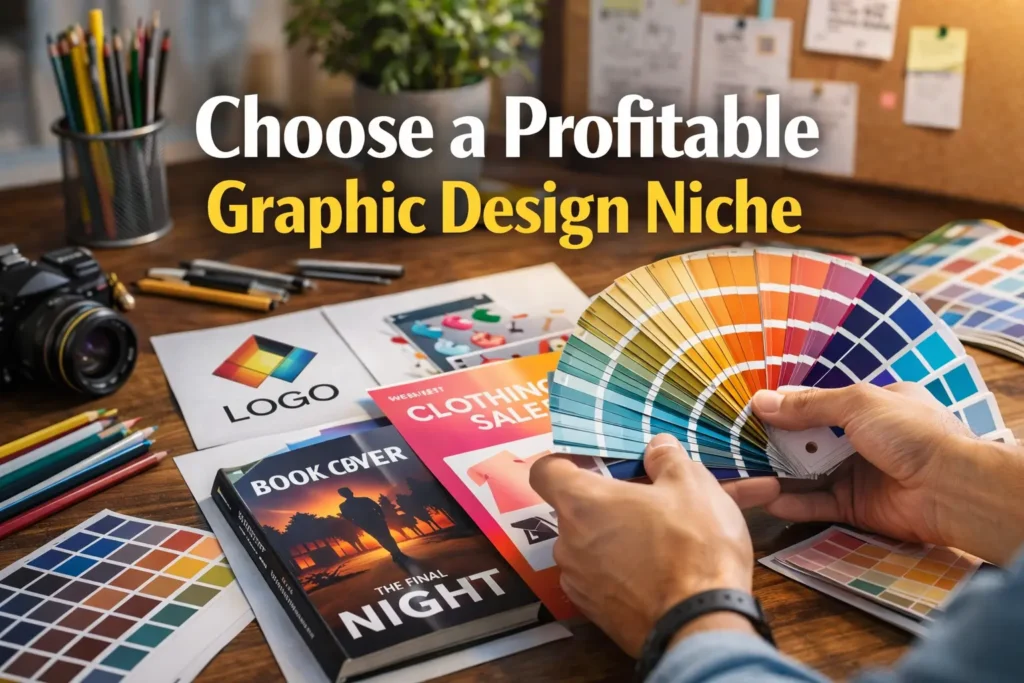
1. Choose a Profitable Graphic Design Niche
Specialization is one of the most important graphic design freelancing tips. Designers who position themselves clearly earn more and attract better clients.
Why General Designers Struggle
Many designers try to offer:
- Logos
- Social media posts
- Websites
- Packaging
- Everything else
This creates two problems:
Too much competition – You compete with thousands of similar profiles.
No clear positioning – Clients don’t understand what you’re truly best at.
When your positioning is unclear, clients hesitate. When it’s specific, they feel confident hiring you.
High-Demand Design Niches in 2026
Instead of being “just a graphic designer,” consider specializing in high-demand areas:
- Logo Design – Ideal for startups and small businesses
- Brand Identity Design – Full branding systems, guidelines, and visual direction
- Social Media Graphics – Ongoing content for brand
- UI/UX Design – Website and app interfaces
- Packaging Design – Product-focused visual branding
- Web Design – Landing pages and marketing websites
Choose one primary niche and refine your expertise around it.
How to Validate Niche Demand
Before committing to a niche, confirm that clients are actively paying for it.
Research on:
- Upwork
- Fiverr
When validating demand, check:
- Job volume – Are new projects posted regularly?
- Budgets – Are clients paying sustainable rates?
- Top-rated designers – How are they positioning themselves?
If you see consistent demand and strong earnings in that niche, it’s a good opportunity.
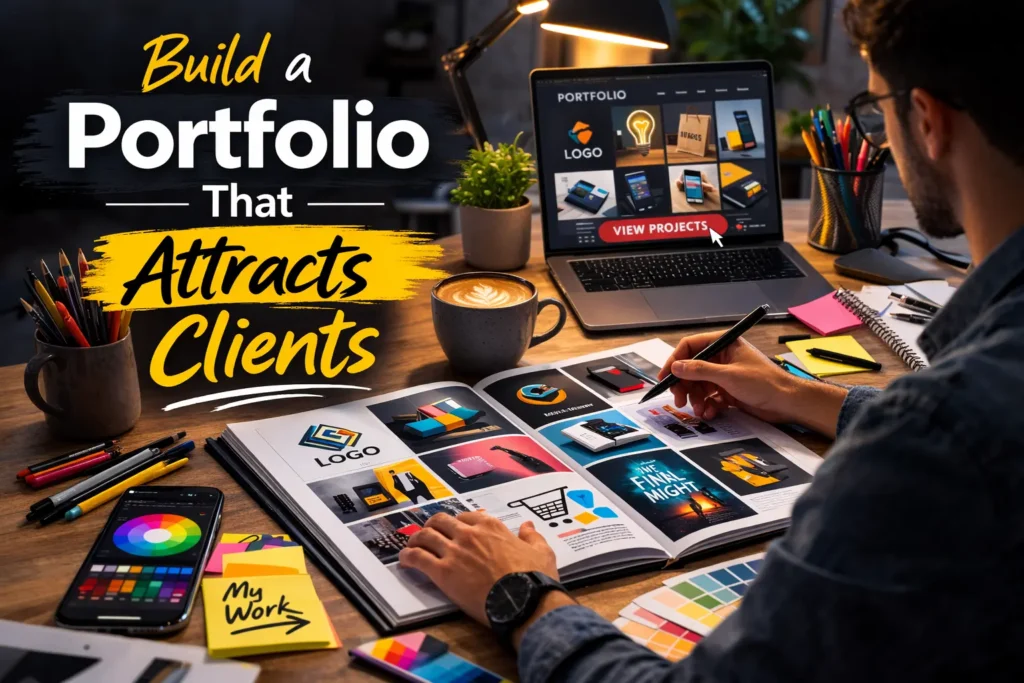
2. Build a Portfolio That Attracts Clients
Your portfolio is your strongest sales tool. Clients hire based on proof, not promises.
Case Study Format for Designers
Instead of uploading random visuals, structure each project as a case study:
- Client Background – Who was the client? What industry?
- Design Challenge – What problem needed solving?
- Process Explanation – How did you approach the project?
- Final Solution – What did you deliver?
- Result – Engagement growth, stronger branding, improved user experience, etc.
This shows strategic thinking — not just design skill.
Use Before/After Presentation
Transformation increases perceived value.
Show:
- Old brand vs new brand
- Weak layout vs improved layout
- Unstructured visuals vs cohesive identity
Clear contrast makes your work more impressive.
Show Process, Not Just Final Files
Clients want to see how you think.
Include:
- Sketches
- Wireframes
- Mood boards
- Concept iterations
Process builds trust. It shows professionalism and depth.
Use Mockups Strategically
Professional mockups make your work look realistic and premium.
For example:
- Logo displayed on packaging
- Brand identity on stationery
- Social posts shown in phone screens
Presentation affects perceived value.
Where to Showcase Your Portfolio
Share your work on:
- Behance
- Dribbble
These platforms increase visibility and authority while supporting client acquisition.
3. Optimize Freelance Platforms for Designers
Your freelance profile is not just a portfolio — it is a conversion page. Whether you’re using Upwork, Fiverr, or building authority on LinkedIn, your positioning must be clear and outcome-focused.
Write a Client-Centered Overview
Most designers talk about:
- Their creativity
- Their tools
- Their years of experience
Clients care about: - Revenue
- Conversions
- Brand perception
- Engagement
Structure your overview like this: - Who you help
- What business problem you solve
- How your design impacts results
- Proof or experience
- Invitation to connect
Avoid heavy design jargon. Focus on outcomes instead of technical terms.
Craft a Results-Focused Headline
Your headline should answer one question:
Who do you help, and what result do you deliver?
Avoid:
“Graphic Designer”
Use:
“Brand Identity Designer for E-commerce & SaaS Companies”
This instantly communicates:
- Your niche
- Your target audience
- Your specialization
Specific headlines attract better-fit clients.
Use Keywords Strategically
Freelance platforms have internal search systems. Using relevant keywords improves visibility.
Include natural variations like:
- Logo design
- Brand strategy
- UI/UX design
- Social media design
Place keywords in:
- Headline
- First paragraph
- Skill tags
- Portfolio descriptions
Balanced keyword usage improves discoverability without sounding forced
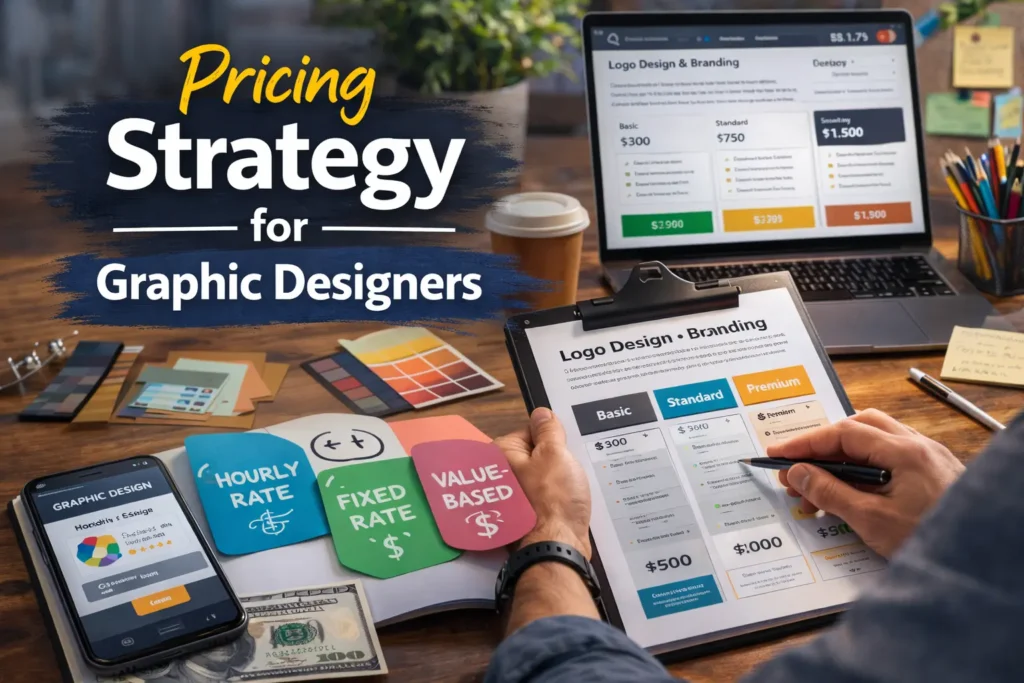
4. Pricing Strategy for Graphic Designers
Pricing is where many talented designers struggle. A strong pricing strategy builds confidence and attracts better clients.
Hourly vs Project-Based Pricing
Hourly Pricing
- Easier for beginners
- Suitable for small tasks
- Limits earning potential
Project-Based Pricing
- Focuses on outcomes
- Encourages efficiency
- More profitable for branding work
For branding and identity design, project pricing is preferred. It aligns better with value delivered.
Branding Package Structure
Instead of quoting random prices, create structured packages.
Example:
Basic Logo Package
- 2–3 concepts
- 2 revision rounds
- Final logo files
Standard Brand Identity Package
- Logo suite
- Color palette
- Typography
- Brand guidelines
Premium Full Branding System
- Full brand identity
- Social media kit
- Packaging mockups
- Website visuals
Avoid the Cheap Designer Trap
Low pricing may attract early clients, but it often leads to:
- Excessive revisions
- Poor communication
- Low respect for your time
Price fairly based on value. Clients who pay more usually expect professionalism and provide better collaboration.
When to Increase Your Rates
Increase your rates when:
- You’re fully booked
- You receive strong testimonials
- Clients rarely negotiate
- You have high retention rates
Gradual rate increases reflect growth and market positioning.
5. Write Winning Proposals as a Graphic Designer
Your proposal is not a résumé. It is a micro sales pitch tailored to one specific client. In competitive platforms and direct outreach, designers who personalize proposals consistently outperform generic applicants.
Opening Hook Strategy
Start by mentioning the client’s brand directly.
Example:“I reviewed your skincare brand, and I love your minimalist packaging concept. However, your current typography feels slightly inconsistent across platforms, which may impact brand recognition.”
This immediately shows:
- You did research
- You care about their business
- You’re not copy-pasting
Avoid long introductions about yourself. Start with them.
Show Design Understanding
Demonstrate that you understand their challenge.
Reference:
- Weak visual hierarchy
- Inconsistent brand identity
- Low engagement on social graphics
- Outdated website UI
- Packaging that lacks shelf appeal
Instead of saying:
“I can design a logo for you.”
Say:
“I can refine your visual identity to improve brand consistency and make your packaging more premium and memorable.”
Speak in business language, not just design language.
Share Relevant Portfolio Sample
Never attach random work.
Link to:
- A similar industry project
- A similar design style
- A similar brand transformation
Briefly explain why it’s relevant:
“Here’s a recent branding project I completed for a SaaS startup with similar positioning.”
Context builds trust. Relevance increases response rate.
Clear CTA (Call to Action)
End with a simple next step.
Examples:
- “Would you be open to a 15-minute discovery call to discuss your vision?”
- “I’d be happy to outline a quick concept direction before we proceed.”
- “Let’s schedule a short call to align on goals and timeline.”
Clear CTAs reduce friction and increase replies.
6. Handle Revisions and Scope Creep Professionally
Revisions are part of design. Unlimited revisions are not. Professional designers manage expectations before problems arise.
Set Revision Limits
Include revision limits in every agreement.
Example:
- 2–3 revision rounds included
- Major changes after concept approval billed separately
This protects:
- Your time
- Your income
- Your mental energy
Clients respect structure.
Define Scope Clearly
Scope creep happens when deliverables are vague.
Instead of writing:
“Logo design”
Specify:
- 3 initial logo concepts
- 2 revision rounds
- Final files in PNG, SVG, AI
- Brand color palette
Clear deliverables prevent misunderstandings.
Include scope inside:
- Proposal
- Contract
- Invoice breakdown
Clarity = fewer disputes.
Charge for Additional Work
When clients request extra work, stay calm and professional.
Example script:
“That update falls outside the original scope. I’d be happy to complete it for an additional fee of $X. Let me know if you’d like me to proceed.”
Avoid emotional reactions.
Avoid free work to “keep the client happy.”
Professional boundaries increase long-term respect.
Strong proposal writing and scope management are what separate struggling designers from profitable ones.
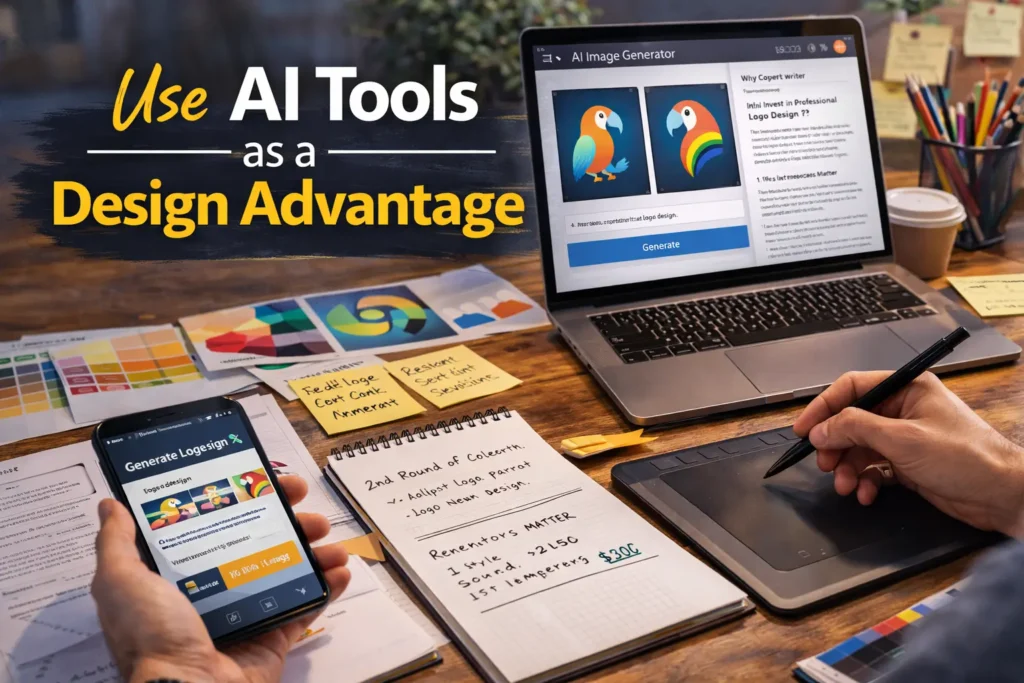
7. Use AI Tools as a Design Advantage (2026 Focus)
AI is not replacing graphic designers. It is replacing slow workflows.
In 2026, smart designers use AI as a creative assistant — not as a creative substitute.
AI for Concept Inspiration
AI tools can accelerate idea generation and mood exploration.
Popular tools include:
- Midjourney – Concept art, style exploration, creative directions
- Adobe Firefly – AI-powered generative visuals inside Adobe workflows
- Canva AI – Quick layout generation, copy suggestions, presentation drafts
You can use AI to:
- Generate early concept directions
- Explore color palettes
- Create mood boards
- Test layout variation
This reduces creative block and speeds up brainstorming.But remember: AI generates options.
You decide what aligns with the brand.
AI for Faster Mockups
AI and smart design tools can help:
- Generate realistic product mockups
- Create packaging previews
- Visualize billboard or storefront placements
- Present social media layouts quickly
Faster mockups increase perceived professionalism.
Clients understand ideas better when they see real-world application.Speed improves efficiency.
Presentation improves conversion.
Why Human Creativity Still Wins
AI can generate visuals.
It cannot understand brand psychology deeply.
Strong designers win because they provide:
- Strategic brand alignment
- Market positioning insight
- Emotional storytelling
- Audience targeting awareness
- Conversion-focused thinking
Design is not decoration.
It is communication.
AI assists. Designers lead.The future belongs to designers who combine:
Human creativity + Strategic thinking + AI efficiency.
8. Build Long-Term Clients Instead of One-Off Projects
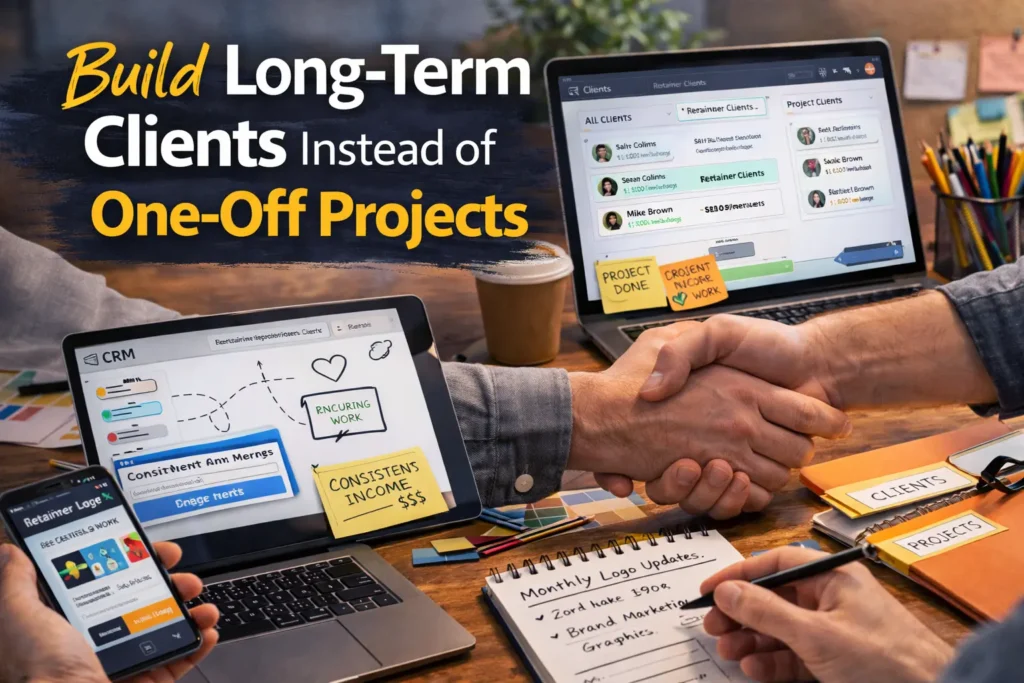
One-time logo projects create temporary income.
Long-term clients create stability and growth. Freelance design becomes sustainable when you focus on retention.
Offer Brand Retainers
Instead of completing one project and disappearing, offer ongoing support.
Example retainers:
- Monthly social media design packages
- Ongoing brand asset creation
- Website visual updates
- Ad creative refreshes
- Product launch design support
Position it like this:
“To maintain brand consistency and growth, I recommend ongoing creative support.”
Retainers create:
- Predictable income
- Stronger client relationships
Less time spent chasing new leads
Upsell Design Add-Ons
After completing a project, identify additional needs.
If you design a logo, suggest:
- Social media brand kit
- Email template design
- Packaging extensions
- Brand guideline document
- Website visual assets
If you design packaging, suggest:
- Promotional banners
- In-store display graphics
- Product launch visuals
Clients often need more than they initially realize.
Your job is to guide them.
Ask for Testimonials and Referrals
After successful delivery, ask professionally.
Example:
“I’m glad you’re happy with the results. If you’re comfortable, I’d really appreciate a short testimonial. Also, if you know anyone who needs branding support, I’d be grateful for an introduction.”
Testimonials build trust.
Referrals bring warm leads.
Warm leads convert faster and pay better.Long-term success in graphic design freelancing is not about doing more projects.
It’s about building deeper relationships.
9. Common Graphic Design Freelancing Mistakes
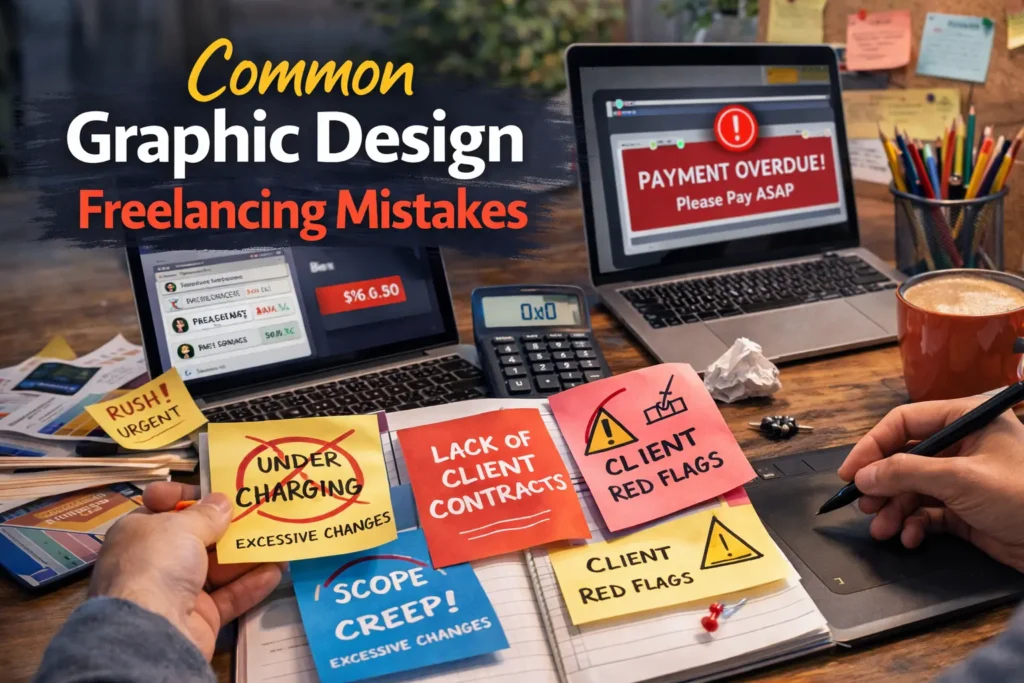
Many talented designers struggle in freelancing — not because of skill, but because of avoidable mistakes. Avoid these early to protect your growth and income.
Accepting Unlimited Revisions
Unlimited revisions sound client-friendly, but they destroy profitability.
Without limits:
- Projects drag on
- Scope expands
- Your time gets consumed
Always define:
- Number of revision rounds
- What qualifies as a revision
- Additional charges for extra changes
Structure creates respect.
Ignoring Contracts
Skipping contracts to “keep things simple” is risky.
Without clear agreements:
- Payment delays happen
- Scope creep increases
- Ownership confusion arises
Even simple projects should have:
- Defined deliverables
- Payment terms
- Revision limits
- Timeline
Professional designers protect their work legally.
Overcomplicating Designs
Beginners often try to impress with complexity.
Too many colors.
Too many fonts.
Too many visual elements.
Strong design is about clarity and communication — not decoration.
Clients care about brand impact, readability, and usability.
Simple, strategic design usually converts better than overly artistic layouts.
Underpricing
Charging extremely low rates may help you get projects quickly — but it often attracts difficult clients and unsustainable workloads.
Low prices signal:
- Inexperience
- Low confidence
- Low perceived value
Instead of competing on price, compete on positioning and results.
Remember: premium clients look for quality, not cheap labor.
Not Building Authority
Relying only on freelance platforms limits growth.
If you’re invisible outside marketplaces, you compete on price.
Authority reduces competition.
Visibility increases inbound opportunities.
Designers who build personal brand authority attract better clients automatically
10. Build Personal Brand Authority as a Designer
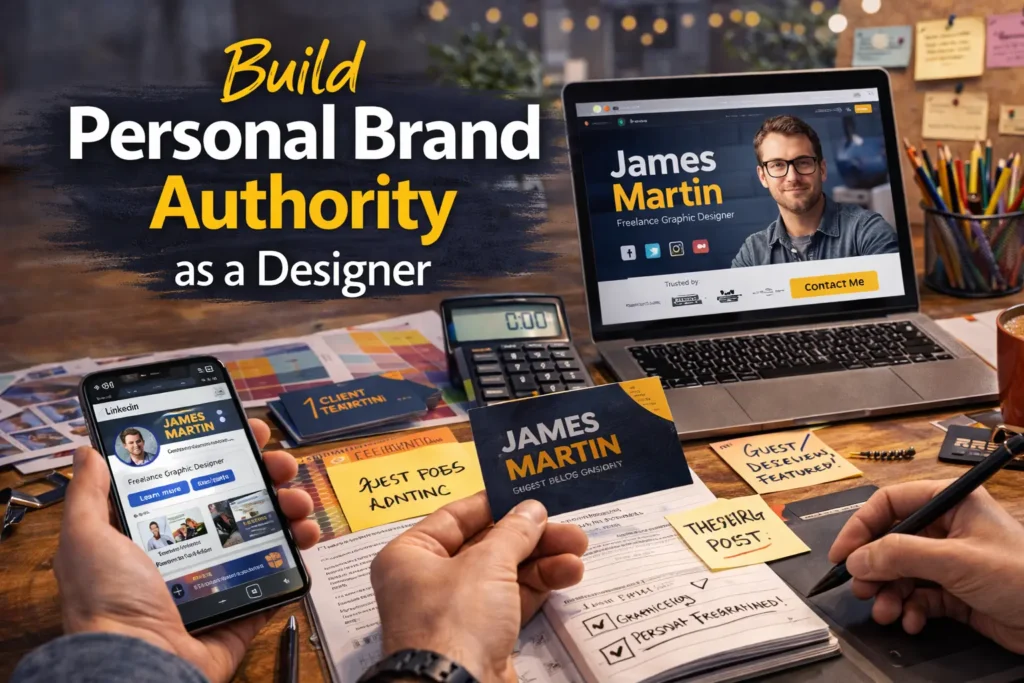
Authority makes clients approach you instead of the other way around. When people see you as a specialist, pricing pressure decreases and trust increases
Post Design Breakdowns on LinkedIn
Instead of just posting final visuals, explain:
- The client challenge
- Your design strategy
- The reasoning behind color and typography
- The results achieved
Design breakdowns show thinking, not just aesthetics.
On LinkedIn, business owners care about outcomes.
Speak their language.
Share Case Studies
Create structured posts or articles explaining:
- Problem
- Process
- Solution
- Measurable result
Case studies build credibility and differentiate you from designers who only share visuals.
Proof attracts premium clien
Build an Audience on Behance or Dribbble
Platforms like Behance and Dribbble help you:
- Showcase high-quality work
- Get discovered by agencies and startups
- Build recognition in the design community
Consistency is key.
Regular uploads improve visibility.
Network with Startup Founders
Startup founders constantly need:
- Brand identity
- Website visuals
- Pitch deck design
- Social media creatives
Engage with them on:
- Startup communities
- Online networking groups
Frequently Asked Questions About Graphic Design Freelancing
Conclusion: Build a Sustainable Graphic Design Freelance Career
Graphic design freelancing in 2026 is no longer just about creating beautiful visuals. It’s about choosing a profitable niche, building a results-driven portfolio, pricing your services strategically, and using AI as a competitive advantage.
Designers who specialize stand out. Designers who show measurable results win better clients. Designers who price based on value — not hours — increase their income ceiling. And those who combine human creativity with AI efficiency move faster than the competition.
If you want long-term success, stop thinking like a task-based freelancer and start thinking like a brand strategist. Build authority. Protect your time. Raise your standards. Position yourself for growth, not just short-term gigs.
Now it’s your turn to take action.
Want broader strategies? Explore our complete guide on Freelancing Tips.
Just starting out? Read Freelancing Tips for Beginners.
Planning to use platforms? Check out our Upwork Freelancing Tips guide.
Your freelance design business grows with every system you build today.